
shockwave and laser - can they beat Sciatic pain?
When to Try BDS Methods for Sciatica vs Conventional Treatment
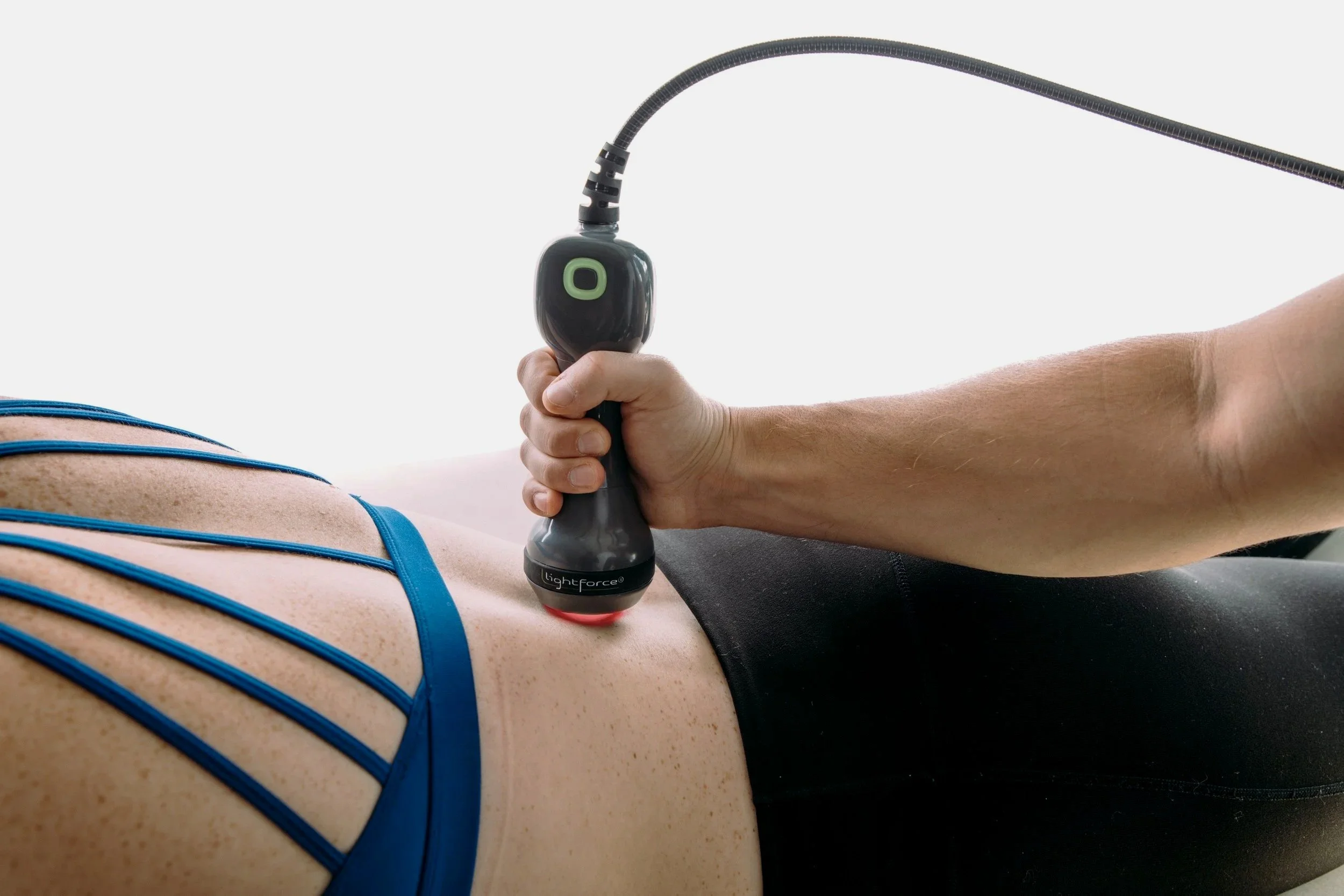
Lightforce Class IV Laser being used on a patient’s lower back at the origin of the sciatic nerve. Pictured Above
If you are dealing with sciatica in the Bridgewater, MA area you are in luck
Sciatica is one of the most frustrating types of pain people deal with, often starting in the lower back and travelling into the hip or down the leg, making sitting, walking, and training difficult.
Most people immediately look toward conventional treatment options. In many cases, that is the right move. But not all sciatica responds the same way, and not every situation requires the same approach.
When doing regular daily activities becomes about limiting movement and making concessions just to have some semblance of a normal life, that is when patients come to us to think outside of the box and get their pain under control without invasive procedures or drugs.
Understanding when to follow conventional care and when to consider a movement-based approach like BDS Methods can make a major difference in how quickly you improve, and the intention of this brief guide is to help you decide if we are the right fit for you.
The Bottom Line…
Conventional care is essential when symptoms are severe, acute, or medically complex.
BDS Methods is most useful when:
symptoms are persistent or chronic
progress has stalled
and you are ready for a more practical, movement-based path forward
You are a strong candidate for this approach if:
Your symptoms are persistent but not worsening
You have already tried rest or basic care
Your pain changes based on movement
You want to stay active but do not know how to manage symptoms
You are not seeing progress with generalized treatment
What Conventional Treatment for Sciatica Typically Looks Like
Traditional care for sciatica often follows a standard progression:
Activity modification or rest
Anti-inflammatory medications
Physical therapy
Imaging (if symptoms persist)
Injections or surgical referral in more severe cases
This model is effective, especially when symptoms are severe, worsening, or associated with neurological changes.
Clinical guidance generally supports conservative care as the first-line approach, with escalation only when symptoms do not improve or worsen over time. You should prioritize conventional care if you have progressive weakness in the leg, loss of bowel or bladder control, severe or unrelenting pain, recent trauma or injury, symptoms that are rapidly worsening
These cases may involve more significant structural issues and require medical assessment before anything else.
You should continue with traditional care if:
Your symptoms are acute and severe
You are early in the injury process
You have neurological deficits
You have been advised toward imaging or intervention
Where BDS Methods Fits In
BDS Methods is not a replacement for medical care. It is a movement and recovery-focused approach that fits into a different part of the process.
This approach is most useful when:
Pain has been present for weeks or months
You have already tried rest or basic treatment without lasting results
Symptoms fluctuate based on movement or activity
You feel stuck between “doing nothing” and “pushing through pain”
We find that this is where many people unfortunately fall through the cracks.
Why Sciatica Often Doesn’t Fully Resolve
Sciatica is not always just a structural problem. It is often influenced by how you move, how you load your body, and how sensitive the nerve has become over time. In general we find that most people who are dealing with sciatic pain tend to either avoid movement too much or continue activity without adjusting how they move.
How THE BDS Approach Differs
At BDS Methods, our focus goes beyond reducing pain in the moment and extends to changing how your body handles movement as a whole because our goal is to reduce irritation while rebuilding tolerance.
If you are the right candidate for alternative sciatic pain management, a program for you may look like the following:
Bodywork to reduce surrounding tension
Movement adjustments based on symptom response
Gradual exposure to loading
Class IV red/near-infrared laser therapy
In some cases, targeted use of shockwave therapy
Where Shockwave Therapy Fits In
Shockwave therapy is not a primary treatment for sciatica itself, but it can be used to address contributing factors.
In musculoskeletal conditions, ESWT has been shown to improve pain levels, musculoskeletal function, and support healthy tissue adaptation over time
Shockwave therapy is does this by:
reducing tension in surrounding tissues
improving mobility in restricted areas
decreasing local tissue sensitivity when using effected muscles
This can make movement more tolerable, which is where real progress happens!
Shockwave therapy is not a primary solution, but it can support recovery when used appropriately. Learn more about how shockwave therapy works for pain and movement issues.
Where Class IV Laser Therapy Fits In
Class IV laser therapy (red and near-infrared light) is used to support tissue recovery and reduce irritation in affected areas. Like shockwave therapy, it is not used as a standalone fix. It is used to help reduce sensitivity and create a better environment for movement-based recovery.
Research on photobiomodulation (laser therapy) suggests it may:
reduce pain in musculoskeletal conditions
improve local circulation
support cellular activity involved in tissue repair
In the context of sciatica, it may be applied to the lower back, gluteal region and/or surrounding soft tissue contributing to irritation.
Still dealing with sciatica that isn’t improving?
If you are in Bridgewater, MA and want an approach that combines movement, bodywork, shockwave therapy, and Class IV laser, BDS Methods provides a more individualized path forward.
